

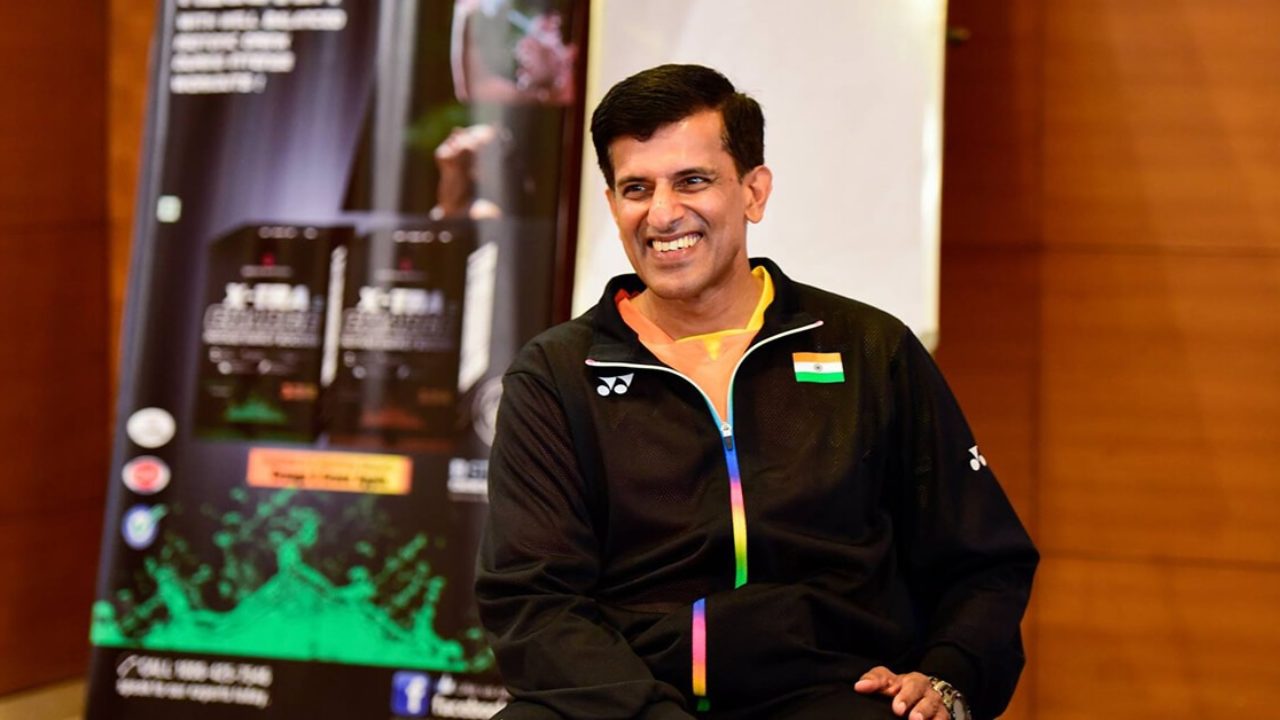
Vimal Kumar was the hands-on manager of the 2022 Thomas Cup team, which made history by taking the coveted trophy beneath the noses of the three previous winners – Malaysia, Denmark, and 14-time champions Indonesia – who had no idea what hit them as India thrashed them 3-0.
Kumar is a two-time national champion, a fantastic instructor and administrator who has organised numerous tournaments at all levels, including international events. He helped Saina Nehwal become the world No. 1 and has a big role in coaching India’s current sensation. From the age of nine, Lakshya Sen has been under his cautious eye.
He is the Director and Chief Coach of the Prakash Padukone Badminton Academy, and he was India’s Chief Coach before Pullela Gopichand took over. He’s a straightforward man who is soft-spoken but not scared to express himself. The Badminton Association of India (BAI) offered him the position of coach of the team for the Thomas Cup, but he chose to go as supervisor since he thought the supervisor’s position would suit him better.
What was the role of the assistants, how did they perform, and what exactly did you do? I was quite clear in my mind about what everyone needed to do during the tournament. But, before I go any further, let me remind you that, at a selectors meeting in March, I told everyone there that we had a very strong and balanced group and that we must always contemplate winning the cup. And the planning should begin right now.
They initially assumed I was communicating through my headgear. However, I was confident that we would succeed. When you look at the team composition, you’ll notice that each of the singles players are true world-beaters, and in Saisatwik/Chirag, we have a powerful and experienced tandem that can take on anyone on the planet. So you look at it from every angle and you’ll see my point of view. So my task, as well as the jobs of the helpers, was apparent. This includes Korea’s Yoo Yong Sung and Siyadath Ullah, DK Sen, and, of course, Denmark’s Mathias Boe for doubles with Vijaydeep and Nidhi Chowdhury.
The physio and others, such as Kiran, Abdul, Sumanish, and Evangeline, are skilled, thus they kept all of the gamers’ nuts and bolts in functioning order. Together with HS Prannoy after he fell and hurt his ankle, and getting him ready for the finals in a short amount of time. We made sure that singles coaches were thinking about their players and that doubles coaches were doing their job.
Then I told the team about our staff meetings, which are vital if you want to have a good time with your coworkers. So we met the night before the game to decide on the team composition, and then we met courtside to have quick chats regarding everyone’s efficiency. I wanted the staff composition as soon as possible because I needed to send it to the Badminton Federation of India (BWF) at least 4 hours before the tie.
Within the conferences, everyone was free to express themselves. And I’m happy to report that the two veteran players, [Kidambi] Srikanth and Prannoy, acted as mentors to the younger players, offering advice and supporting them through their anxieties. The whole thing fell into place quickly, and the squad genuinely gelled. Each member of the team was starving for satisfaction.
Throughout the squad, there was excellent coordination, cooperation, and togetherness. Nothing else was important. What was the reaction of the personnel to Taipei’s loss in the Chinese language? The loss didn’t bother the players since they fought back regardless of how they felt.
On the courtside assembly, there was a hearty chuckle. We were in the quarterfinals, and we wanted to forget about our loss and concentrate on who we faced after a little break. Nothing was misplaced, and we were overjoyed when we learned that we would be facing Malaysia in the quarterfinals.
However, as fate would have it, we won our quarterfinals, whereas Chinese language Taipei lost their quarterfinals versus Malaysia. With the exception of the first singles, when Lee Zhi Jia, the former all-England winner, was set to face Lakshya, who was still recovering from food poisoning, we thought we had a decent chance.
Srikanth and Prannoy both expressed confidence in their matches, while Saisatwik and Chirag both indicated that they have a strong chance of winning theirs. We had shrugged off our setback in front of the Taipei team. We won because the players pushed themselves to the limit toward Malaysia.
As far as they can tell, the rest is history. Do you think the current approach of bringing all 16 teams to a single location to play the Thomas Cup and Uber Cup in 8 days is healthier, or do you think we should always try something new? Good question. This gives me a strong feeling. Did you notice that each Thomas Cup semifinal was held on adjacent courts?
The audience was perplexed as to which match to watch. The Thomas and Uber schedules were both extremely tight. The BWF wished for the end of the world in less than eight days. I feel that, like the Davis Cup in tennis, we must always communicate a system.
Matches must be decided by a coin flip or something similar in foreign settings. Keep in mind that this was the system in place prior to 1982. You performed in 1979, when the old system was still in place. We played Sri Lanka in India and were supposed to move to Pakistan for the next round, but they backed out, instead we played Malaysia in the Asian zone finals in Kuala Lumpur.
This type of approach will boost the game’s reputation because fans will support their home team. Extra media protection will be provided. The Thomas Cup may be over for a few months, but the BWF may reserve the specified weekends for inter-country matches.
Although this may appear revolutionary, I believe a significant change is required. What needs to be completed in India to ensure a lasting legacy for this monumental achievement? What will we build on top of this? This is the first bet on the Thomas Cup triumph. Bring the sport to a wider audience.
Allow us to transport the cup in an open jeep through major cities where badminton is popular, such as Bangalore, Hyderabad, Guwahati, Mumbai, Pune, and possibly Chandigarh. Begin in Pune, the birthplace of popular badminton.
This is going to be symbolic. It will ensure that you stay in the spotlight and focus on the game. And we should bring back the system of watching matches in the Thomas Cup format against teams from Thailand, Denmark, Malaysia, and other countries. on the basis of reciprocity It might be for those aged 17 to 19, then for those aged 19 and under.
These matches should take place in smaller towns. The game will attract more specialists from throughout the country. It will also provide positive publicity for the children. Finally, I’d like to see the Indian badminton league (IBL) restored. It was a terrific source of exposure for our juniors and younger players.
They saw world-beaters up close, played with them, travelled with them, and learned a lot from them. This was quite beneficial to us. We also got our top-class doubles coach, Boe Mathias, from the league. These are some of the factors and considerations that BAI should consider.
